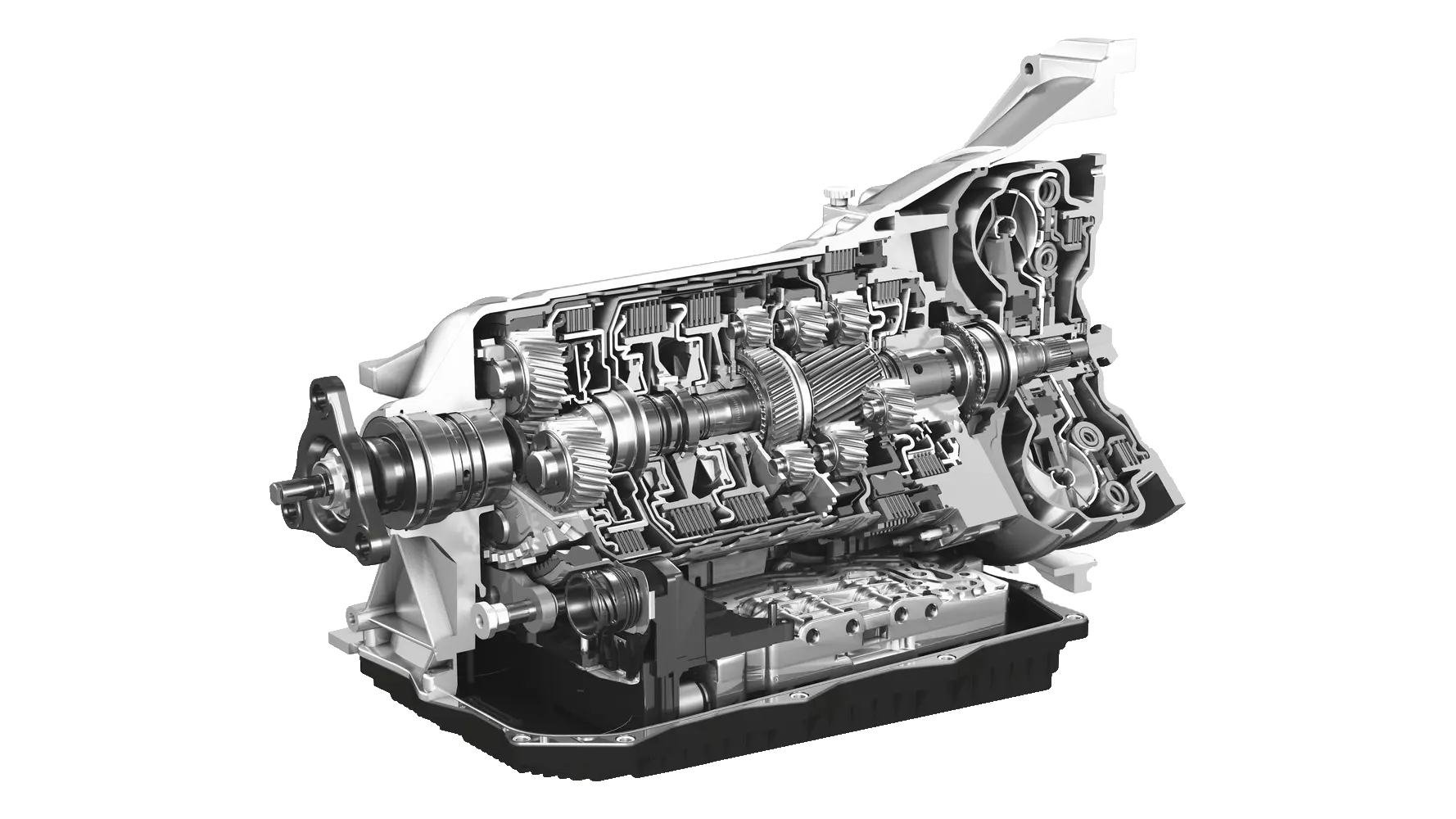
The ZF 8HP is one of the most successful automatic gearboxes ever made, fitted to BMW, Audi, Land Rover, Range Rover, Jaguar, Porsche, Jeep and many more. Its mechanical parts are extremely strong, but it’s highly sensitive to fluid condition and electronic calibration. When it goes wrong, most owners hear the same thing from a main dealer: replace the whole gearbox.
Often that isn’t necessary. Here’s what actually goes wrong, which version you have, and how it’s fixed.
The ZF 8HP in a nutshell
According to ZF, the 8HP covers engines from around 220Nm to 1,000Nm, everything from small 3-cylinders to V8s, in rear-wheel and all-wheel-drive cars. Inside, four gear sets are controlled by five shift elements (three multi-plate clutches and two brakes), with only two open in any gear, which is what makes it so smooth and efficient. It’s available as a conventional, mild hybrid or plug-in hybrid gearbox.
That precision is also why it’s so sensitive to fluid condition and correct programming. When something’s slightly off inside, you feel it.
Which ZF 8HP do you have?
“ZF 8HP” isn’t one gearbox. It’s a whole family, built in different sizes over four generations since 2009. The number in the name tells you roughly how much torque it’s built for (45 is around 450Nm, 75 is around 750Nm), and gear ratios vary between versions and cars. The exact version decides the parts, the fluid and the right repair.
The three we see most
ZF 8HP45: the everyday workhorse (around 450–500Nm)
The original mid-size 8HP, and one of the most common automatics on UK roads. Found across rear-wheel-drive BMWs: the 1 Series (F20, up to 2019), 2, 3, 4, 5, 6 and 7 Series, and the X1 (E84, up to 2015), X3, X4, X5 and X6, plus the Jaguar XE, XF and XJ and early Range Rover (L405) models. With so many now at high mileage, fluid-related wear and torque converter shudder are common.
ZF 8HP65: the Audi, Porsche and VW version (around 650Nm)
Fitted to many later Audis, including the A4 (B9), A6 and A7 (C8), A8 (D5), Q7 and Q8, as well as the Porsche Cayenne and VW Touareg from 2018. Audi versions carry an “A” (8HP65A), meaning the front differential is built into the gearbox for quattro all-wheel drive.
ZF 8HP75: for big diesels and performance cars (around 700–740Nm)
The heavy-duty second-generation unit, fitted to the BMW 5 and 7 Series, X5 and M5 (F90), Land Rover Discovery and Defender, Alfa Romeo Giulia and Stelvio Quadrifoglio, Aston Martin DB11 and Vantage, and Jeep Grand Cherokee and Wrangler. These cars are heavy and powerful, which puts extra load on the clutches and fluid.
Performance builds. Beyond repairs, we do bespoke performance gearbox builds, including upgraded 8HP gearboxes for the latest Toyota GR Supra and BMW models. See our performance gearbox builds →
The rest of the family
Smaller units
- 8HP30: the smallest version, for lower-torque engines.
- 8HP50: second-generation replacement for the 8HP45. BMW 1 Series (F20, up to 2019), 3, 4, 5 and 7 Series, X3, X4 and X7; Jaguar F-Pace and XF; Land Rover Defender; Alfa Romeo Giulia and Stelvio
- 8HP51: third generation. BMW 2, 3 (G20), 4 (G22) and Z4 (G29), X3 M40i and X4 M40i; Toyota GR Supra; Ineos Grenadier (petrol)
Mid and large units
- 8HP55: Audi A4/A5 (B8/8.5, some markets), A6 and A7 (C7), including the A6 Hybrid
- 8HP70: the first 8HP, from 2009. BMW 5 and 7 Series; Jaguar F-Type and XJ; Maserati Ghibli and Quattroporte; Aston Martin Rapide S and Vanquish; Rolls-Royce Phantom
- 8HP76: third-generation high-torque unit. BMW 730d, 8 Series, M3, M5, M8, X5 M and X7; Ineos Grenadier (diesel)
- 8HP80: fourth generation (from 2022). BMW 7 Series (G70), X5, X6 and X7
The most powerful
- 8HP90: Audi A8 (D4) and RS6 (C7); Bentley Mulsanne and Continental GT; Rolls-Royce Ghost and Wraith
- 8HP95: Audi RS6, RS7, RS Q8, SQ7 and S8; Bentley Bentayga and Flying Spur; Lamborghini Urus; Porsche Cayenne Turbo; Rolls-Royce Cullinan
- 8HP100: the latest and strongest (around 1,000Nm), in the BMW XM and new M5
Not every BMW has a ZF. The 1 Series from 2019 (F40), the X1 from 2015 (F48 onwards) and other front-wheel-drive-based BMWs use an Aisin 8-speed or a 7-speed dual-clutch gearbox instead. If that’s your car, see our Aisin Warner gearbox repair page.
What the letters mean
- A: Audi all-wheel-drive versions, such as the 8HP55A and 8HP65A, with the front axle differential and the drive to both axles built into the gearbox. According to ZF’s workshop manual, these gearboxes have three separate oil systems: the gearbox itself, the front axle and the rear axle output. Each has its own drain and fill points, and all three need the correct oil at the right level. Changing only the gearbox oil and ignoring the other two is a common shortcut, and it costs gearboxes.
- Hybrid versions: many newer 8HPs include an electric motor inside the gearbox, for mild hybrid and plug-in hybrid cars.
Same gearbox, different software
This is what catches most people out. An Audi Q7 and a BMW X5 both use a ZF 8HP of a similar size, yet their gearboxes aren’t interchangeable. Each manufacturer programs the gearbox with its own software, gear ratios and calibration for that car. Even two gearboxes with the same code, from different manufacturers, won’t simply swap over.
That’s why the right part has to suit the exact car, not just the gearbox code, and why every repair finishes with proper programming and adaptation.
It’s also why mechatronic replacement can get expensive. On many Audi models, replacement mechatronic units are only available from main dealers and need dealer-level coding, which pushes the price up. That’s exactly why repairing a mechatronic, where it’s possible, can save so much compared with a dealer replacement.
Exact fitments vary by engine and year, so your registration number is the quickest way to know exactly which 8HP you have. Give us the reg and we’ll tell you.
The “lifetime fluid” myth
BMW and many other manufacturers describe the 8HP’s fluid as “lifetime” fill, meaning it never needs changing. Plenty of owners take that at face value, and plenty of gearboxes pay for it.
ZF, the company that actually designs and builds the gearbox, says otherwise. Its own workshop manuals for the 8HP say the oil should be replaced after 80,000–120,000km (around 50,000–75,000 miles), depending on how the car is driven, or after 8 years. ZF even sells its own oil change kits for the 8HP. You don’t make service kits for a fluid that never needs changing.
ZF also explains why: the oil ages faster at high operating temperatures, which means lots of high-speed driving, towing, or sporty driving. That’s how a large share of UK cars are actually used.
So “lifetime” really means the lifetime of the warranty, not the lifetime of the gearbox. Over time the fluid oxidises, loses its friction properties and fills with wear particles. Neglected fluid is behind a large share of 8HP problems, starting with shift quality and ending in expensive repairs.
Our recommendation: treat ZF’s 8-year / 75,000-mile figure as an absolute maximum, not a target. If your car is driven hard, tows, does lots of motorway miles or sits in stop-start traffic, change the fluid sooner, and keep changing it at regular intervals after that, rather than waiting another 8 years. Fresh fluid is far cheaper than a rebuilt gearbox.
Why an 8HP fluid change isn’t a quick drain and fill
Done wrong, a fluid change can cause the very problems it’s meant to prevent. ZF’s own procedure is strict:
- Only the correct ZF Lifeguard Fluid, with no additives, because they alter the oil’s chemistry
- The level is set with the engine running and the oil at 30–50°C, after filling the torque converter and cycling through the gears
- Too little oil damages the gearbox: flaring revs and burned clutches
- Too much is dangerous: excess oil escapes through the overflow when hot and can ignite on hot parts like the exhaust
That’s why every 8HP fluid service is done to ZF’s specification, with the right fluid, at the right temperature, to the right level.
The most common ZF 8HP problems
1. Torque converter shudder. A brief vibration or “rumble strip” feeling under light acceleration at low speed. Usually the lock-up clutch can’t engage smoothly because the fluid has lost its friction properties.
2. Mechatronic sleeve leak. A plastic sleeve carries the electrical connector into the gearbox, and its seals are a known weak point. When they leak, the fluid level drops, causing erratic shifting, and fluid can wick into the wiring and corrode the connector.
3. Harsh downshifts as you stop. A thump just as the car comes to a stop, often the mechatronic struggling with the pressure handover between the lower gears.
4. Mechatronic and valve body wear. Over time the valves and solenoids wear, especially on high-mileage units with old fluid, leading to slipping, flaring revs or delayed engagement.
5. Software and calibration faults. Because the 8HP relies so heavily on its programming, some faults are electronic rather than mechanical, and are fixed with the correct software and adaptation rather than parts.
6. Drivetrain warning and limp mode. When a clutch takes too long to fill with oil, or the gearbox detects a fault, it may show a drivetrain or gearbox warning and restrict the car.
Symptoms to watch for
- Shudder under light acceleration
- Thump or harsh shift coming to a stop
- Slipping, flaring revs or delayed engagement
- Fluid leak around the gearbox connector
- Drivetrain or gearbox warning and limp mode
Every fault confirmed before a part is ordered
The 8HP records “adaptation values” that show how hard it’s working to compensate for wear in each clutch. Reading them with dealer-level diagnostics shows exactly what’s happening inside, before a single part is ordered.
Repair or replace?
If the hardware is healthy, a correct fluid service, sleeve repair, software update or mechatronic repair can often restore proper shift quality. Where the fault is internal, a rebuild typically costs a fraction of a new gearbox from a dealer.
After any repair, the gearbox must be programmed and adapted so it learns how the new or repaired parts behave. Skip that and even a correct repair won’t feel right. Every repair is adapted and road-tested before the car comes home.
Cutting corners shows here. ZF’s manual is clear that after any clutch or brake damage, the torque converter, oil pipes and oil cooler must be thoroughly cleaned. Otherwise debris from the old failure goes straight back into the repaired gearbox. Every repair is done properly, not just the parts you can see.
How it works with Gearbox Gurus
We collect your car from anywhere in the UK, get every fault properly diagnosed, keep you updated throughout, and return it to your door once the repair is done. Every repair is backed by our minimum 12-month Guru Guarantee.
Call us today on 020 4584 3589.